
A crash gives you very little time to make decisions you have never had to make before. Most people in Florida have not been in one. They do not know who to call. They do not know where to get the car fixed or who is going to pay for it.
Clients have called me from the accident scene because they need direction, and that is why this book starts at the side of the road. The first minutes after a crash set up everything that follows: the insurance claim, the medical record, and, if it comes to it, the lawsuit. This chapter covers getting help, documenting the scene, and finding the people and cameras that saw what happened.
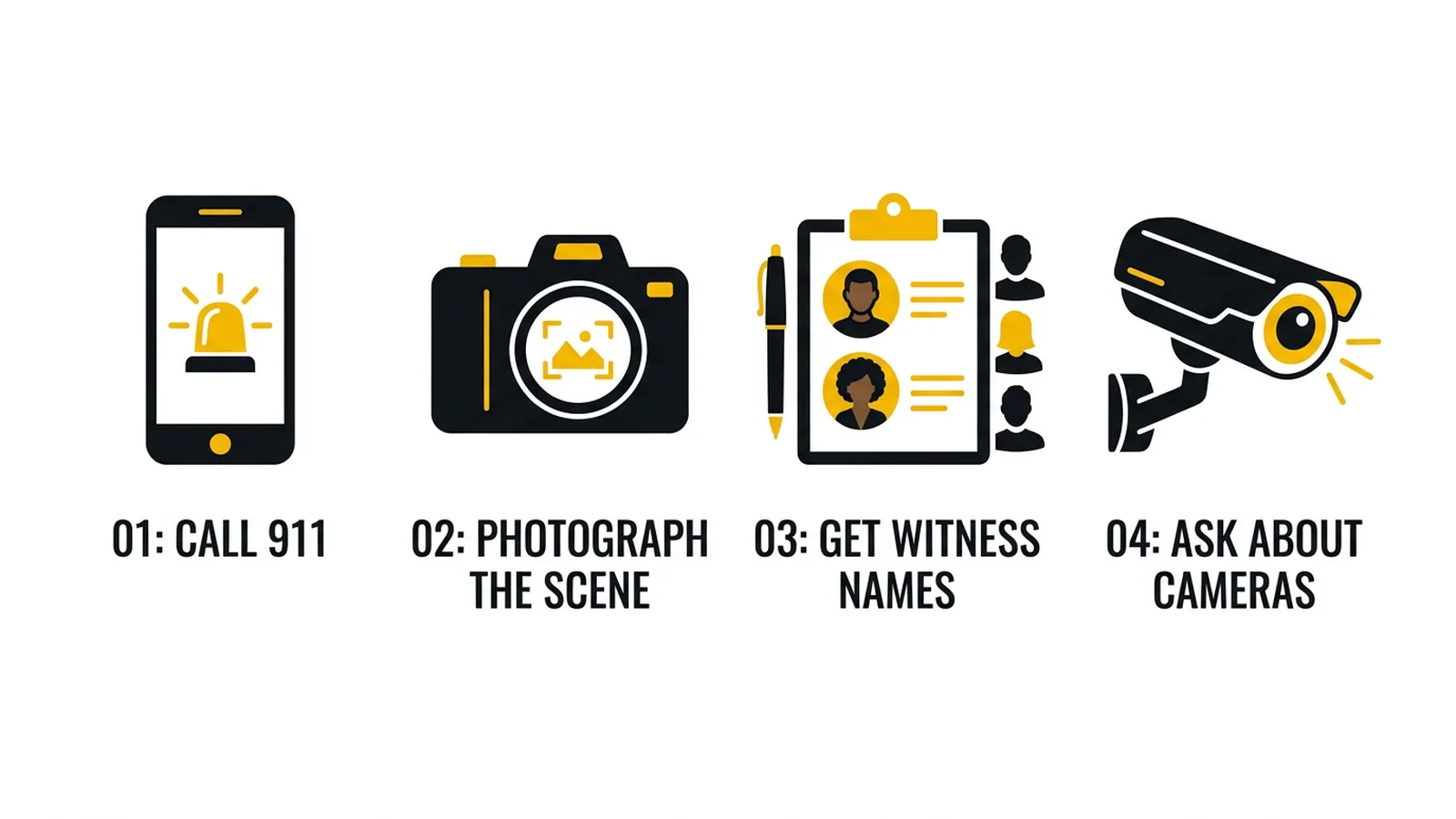
If you can safely pull over to the side of the road, then call 911. You want to make sure that you get officers out there immediately to respond to the accident. They can gather evidence. They can take photos. They can take statements from witnesses.
Call 911 and get officers to the scene
Pull over if you can do it safely, then call 911. I want officers on the scene right away. They gather evidence, take photographs, and talk to the witnesses standing there. If you are injured and feel you need the hospital, you can request EMS from the scene.
Chapter 6 explains why the officer's report matters later. For now the point is simple: get them there.
Photograph what you can safely reach
If you are able to, take photos of the whole scene. Photograph the damage to your vehicle and to every other vehicle involved. Photograph anything on the surrounding roadway. If there are skid marks, capture them. If a traffic light is not working, capture that too.
Do all of it only when it is safe. No photograph is worth stepping into traffic.
Write down what people say
Note any statements anyone at the scene makes. At intersections, both drivers usually blame each other. One says, "I had a green light." The other says, "No, I had a green light." Then it becomes, "Well, I had a green arrow," and, "No, you couldn't have had a green arrow." Neither driver wants to be at fault, so what was said in the first few minutes can matter later.
Find the witnesses before they leave
Look around for anyone who saw the crash. Florida has a lot of snowbirds, people who come down from up north for the winter. If you do not get a snowbird witness's statement right away, that person may be back home in another state. They become much harder to reach, and some do not want any part of what they saw.
For our clients, we request written statements while the memory is fresh. If you are doing it yourself, get a name and a phone number at the very least. The firm's Stuart car accident team does the same for local clients.
Ask about cameras
Look for businesses with cameras that may have caught the crash. Ask them to retain the video or give you a copy. A lot of these systems copy over their footage within twenty or thirty days. Waiting a month can mean the footage is gone.
Watch what you say
People can hurt a claim with their words at the scene. They may give information or admit fault when the fault was not theirs. You do not have to decide who caused the crash on the shoulder of the road. Chapter 3 covers how fault works in Florida, and why it deserves a calmer conversation than the one you will have on the roadside.
Common Questions
- What should I do right after a car accident in Florida?
- Pull over if you can do it safely and call 911 so officers can respond. If you are injured, you can request EMS. Photograph the scene, every vehicle, and the roadway. Look for witnesses and cameras, and keep your comments about fault to a minimum until you understand your rights.
- Should I take photos even if the police come?
- Yes, if you can do it safely. Officers can take photos, gather evidence, and take witness statements, but your photos show what you saw. Capture the damage to your car and the other vehicles, anything on the roadway, skid marks, and a signal that is not working.
- How fast do I need to get witness information?
- As fast as you can, and ideally before people leave the scene. A snowbird witness may go back to another state, and weeks later that person can be hard to find or unwilling to help. Written statements taken while the memory is fresh carry more weight than a recollection months later.
- How long do businesses keep security video?
- In my experience, a lot of them copy over their footage within twenty or thirty days. If a camera faces the crash, ask the business to retain the video or give you a copy right away. Do not assume it will still be there when you finally get around to asking.
Chapter Reflection
The roadside is the one place where the facts are still fresh. A skid mark gets driven over, a witness drives home, and a camera records over itself. Everything that comes later in a claim, from the first call with an adjuster to a jury, is built from what somebody captured in those first hours.