
Fault changed in Florida in 2023. For many years, a driver who was one percent at fault could still recover something. That is no longer the rule. The law now asks a harder question, and it asks it sooner.
This chapter covers what the change means, why proving the other driver's fault comes first, and the shorter clock that came with it.
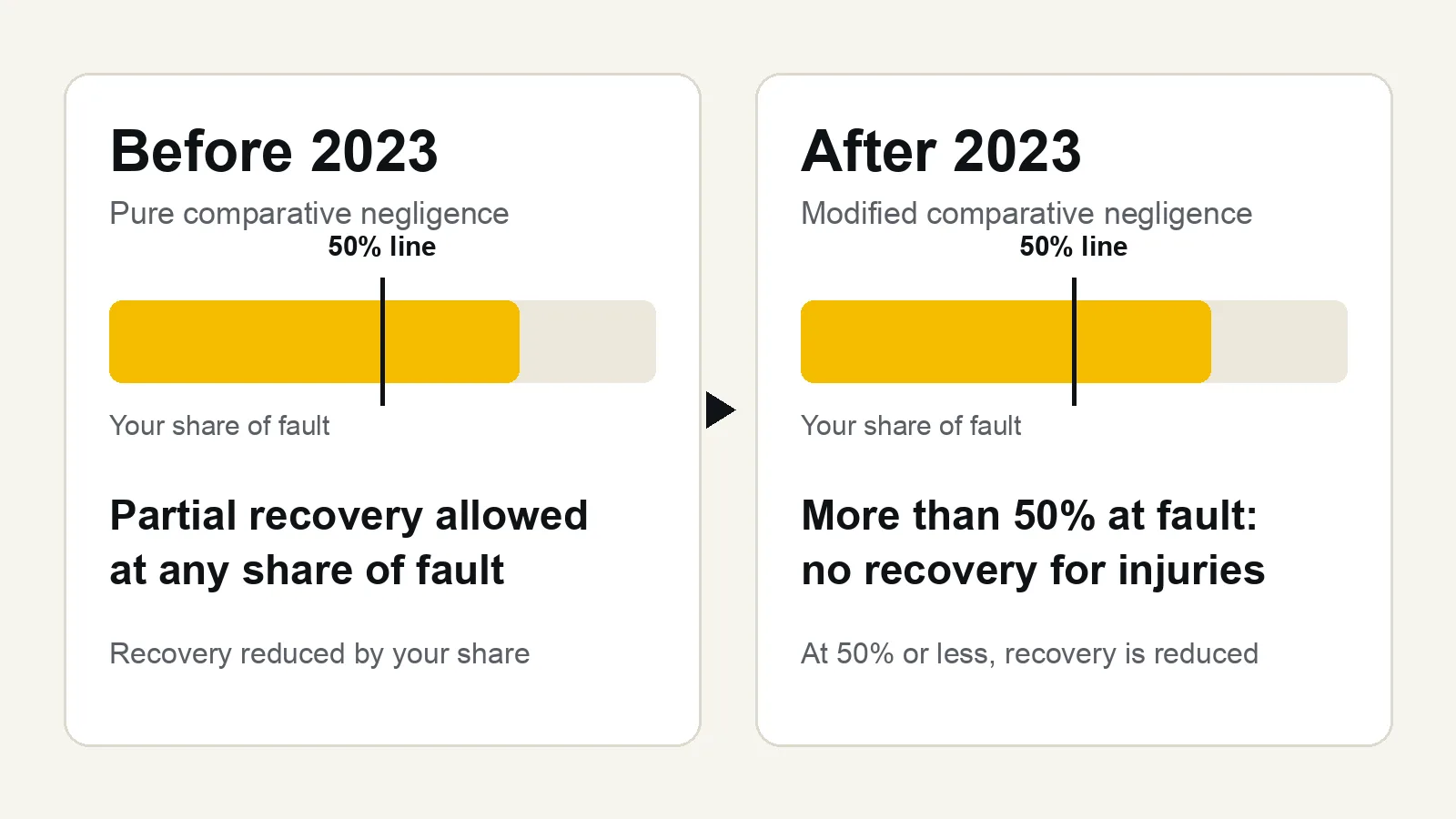
In Florida, it's important to identify the at-fault party, because our law changed in 2023 where if you're determined to be more than 50% at fault for a crash, you may be barred from recovery completely. So you want to make sure that you can establish that you were not at fault for the crash, that somebody else was at fault. And you want to gather as much evidence as you can to help prove that theory.
What changed in 2023
In 2023, House Bill 837 was enacted, and it changed the picture for car accident claims across Florida. Before it, a driver who was only a little at fault could still make a recovery. Now, if you are determined to be more than 50 percent at fault for a crash, you may be barred from recovery completely. Florida's modified comparative negligence statute sets that line.
A jury decides the percentages, which is one reason the evidence you collect early matters so much.
Why you start with the other driver's fault
Because the bar is so severe, the first job is to establish that you were not at fault and that somebody else was. Then you gather as much evidence as you can to prove it. That means the steps in Chapter 1 and the evidence in Chapter 7. The firm's article on how Florida's comparative negligence law affects a car accident claim sits alongside this chapter.
If you think you may share some of the fault, do not decide on your own that the claim is over. That is a conversation to have with an attorney early, before anyone writes down a number.
What your own insurance does if you were at fault
A driver who caused the crash is not left with nothing. If you have collision coverage, it may pay for damage to your vehicle. Your own PIP pays for your injuries and medical treatment regardless of who is at fault, as Chapter 2 explained.
What you cannot count on is a recovery from the other driver if a jury puts most of the fault on you.
The shorter deadline
House Bill 837 also changed how long you have to bring a lawsuit. For crashes after March 24, 2023, the statute of limitations on negligence claims in Florida is two years. Florida's negligence limitation, section 95.11, sets the clock.
Two years sounds like a long time. Between treatment, records, and negotiation, it is shorter than people expect. I say it the same way every time: call us right away.
Crashes with a government vehicle follow different rules. If the other driver was a police officer, a firefighter, an ambulance crew, or another state or local government employee on the job, the claim falls under Florida's sovereign immunity law, section 768.28. You must present the claim in writing to the government before you can sue, and the law caps what you can collect from a government entity at $200,000 per person and $300,000 per incident. If a government vehicle was involved, call an attorney right away.
Common Questions
- What is Florida's 51 percent rule?
- Since 2023, if a jury determines you were more than 50 percent at fault for a crash, you may be barred from recovering damages at all. That is a change from the old rule, under which even a driver who was one percent at fault could still recover.
- Can I recover if I was partly at fault?
- It depends on how a jury assigns the fault. Being partly at fault does not automatically end a claim, but the law now bars recovery above the 50 percent line. Do not decide on your own that you have no case. Talk to an attorney.
- How long do I have to file a car accident lawsuit in Florida?
- For crashes after March 24, 2023, the statute of limitations on negligence claims is two years, shortened by House Bill 837. Because treatment, records, and negotiation all take time, I tell people to call an attorney right after the crash instead of counting down the months. The firm has also published an article on Florida's statute of limitations for different injury cases.
Chapter Reflection
The new rule moved the fight to the beginning. A claim that once could absorb some early mistakes now has to prove, from the start, whose fault the crash was. The people who do best are the ones who treated the first week as the beginning of a case.