
After a crash in Florida, one question comes up fast: how are my medical bills going to get paid? People will tell you that Florida is a no-fault state. That phrase sounds like it settles who is to blame. It does not. It settles whose insurance pays first.
This chapter explains personal injury protection, usually called PIP, along with the deadline and the condition that decides whether it pays at all.
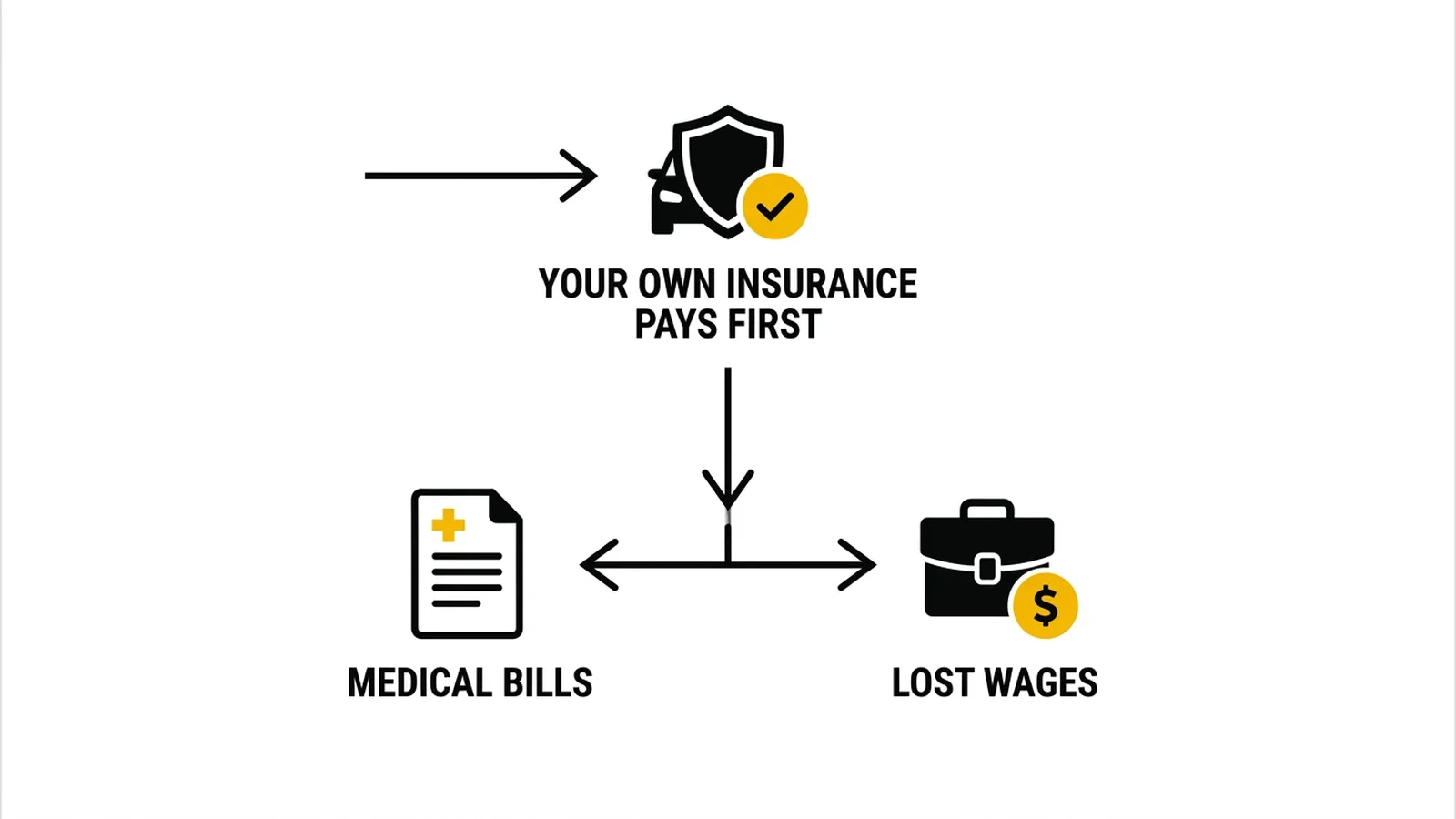
In Florida, we have personal injury protection, which is the Florida no-fault rule. All that means is that your own auto insurance pays your first $10,000 of your medical bills at a rate of 80% and lost wages at a rate of 60%.
What no-fault means
No-fault is the common name for personal injury protection, or PIP. It is part of Florida law that you are required to carry PIP for your own injuries. Two things are covered. Medical bills are covered up to the first $10,000, with the policy paying 80 percent of them. Lost wages are covered too, at 60 percent. Florida's personal injury protection statute, section 627.736, sets out the coverage.
It does not matter who caused the crash. If you are hurt, your own policy responds first.
The 14-day rule
PIP comes with a deadline. You must receive initial services and care within 14 days of the crash for the medical benefits to be paid. Miss that window and the medical coverage you paid for may not pay at all.
I tell people to see a doctor right away, and this is one more reason. Chapter 8 covers medical treatment and how the insurance company reads a delay. The firm's article on what to expect from PIP coverage after a Florida car accident looks at the same subject.
The emergency medical condition requirement
There is a second condition inside PIP. It is called an emergency medical condition, or EMC. You must be treated by certain providers in order to determine whether you suffered an emergency medical condition as a result of the crash.
If no medical provider determines that you have one, your PIP benefits may be limited to only $2,500. That is a small number against a real injury.
Why $10,000 does not go far
We all know how much hospitals cost. Just to go to a hospital costs far more than $10,000. A first ER visit can use up much of the coverage before any follow-up care begins.
Unfortunately, in Florida our laws are not the best for recovery for our clients. PIP gets your treatment started. It does not make you whole, and the firm's overview of how Florida's no-fault insurance system works goes further. For that, a claim against the at-fault driver is often needed, which is what the rest of this book is about. One limit applies to that claim: to recover damages for pain and suffering, the injury must meet Florida's permanence threshold, which Chapter 5 explains.
Collision coverage and your car
PIP covers your injuries. It does not repair your vehicle. If you carry collision coverage, that coverage may pay for the damage to your car. Whether you carry it, and what it pays, is set by the policy you bought before the crash.
Common Questions
- What is PIP insurance in Florida?
- PIP stands for personal injury protection, the coverage people call Florida no-fault. Your own auto insurance pays your first $10,000 of medical bills at a rate of 80 percent, and lost wages at 60 percent. Florida requires you to carry it for your own injuries.
- Does PIP pay if the crash was my fault?
- Yes. As I tell people, it does not matter who is at fault. Your own auto insurance pays for your injuries and your medical treatment regardless of fault. Whether you can also recover from the other driver is a separate question, covered in the next chapter.
- How soon do I need to see a doctor to use PIP?
- You must receive initial services and care within 14 days of the crash for PIP medical benefits to be paid. Waiting past that window is the single easiest way to lose that coverage.
- What happens if no doctor finds an emergency medical condition?
- If no medical provider determines that you have an emergency medical condition, your PIP benefits may be limited to only $2,500. That is why the type of provider who examines you matters, and why waiting to be seen puts the full coverage at risk.
Chapter Reflection
PIP is a safety net with a short fuse. It pays regardless of fault, but only for people who get treated in time and seen by the right providers. After that window closes, the medical coverage you paid for may not be there when you reach for it.