
Chapter 1 told you what to do in the first minutes. This chapter goes deeper on the three kinds of evidence that carry the most weight in a Florida car accident claim: photographs, witnesses, and video.
Each one has an expiration date. That is the common thread, and it is the reason we move on all three in the first days.
It's important to gather witness statements if there are any independent witnesses to a crash. It's important that you get their names, their phone numbers, and signed brief statements before witnesses leave. Independent observers, unlike parties to the crash, have no interest in the outcome and carry significantly more credibility.
Photographs: more than the cars
Capture vehicle damage from multiple angles before the vehicles are moved. Photograph all four sides of every vehicle involved, plus the points of impact. Then photograph the road conditions, the traffic signals, the signage, skid marks, the road surface, the weather, the lighting, and visibility on roads like A1A, US 1, or I-95.
Photograph your injuries before you bandage them. Keep photographing visible injuries as they heal, including bruising and scarring, to show the permanence or disfigurement.
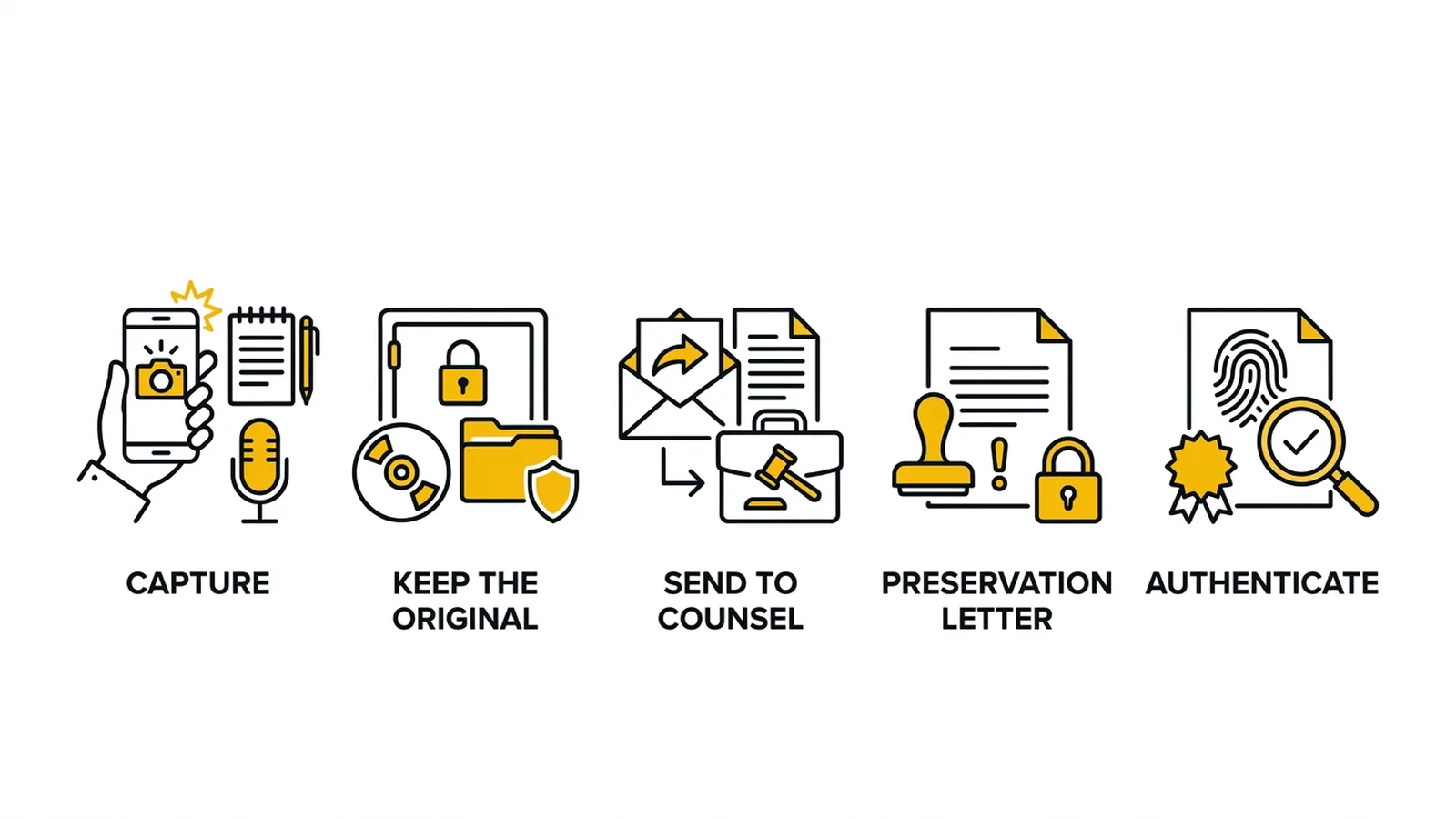
Preserve the original images with all the metadata. A timestamp creates a contemporaneous record that can survive a challenge. Then send the photographs to us within days so we can document the chain of custody: who took them, when, and who has had them since.
Witnesses: why they decide cases
Because a driver's crash report and statements to the officer stay out of evidence, the witness is the person who can put the facts on the record. Independent witnesses are the strongest. In litigation, cross-examination preparation starts with the earliest statements, and the earliest statements are the ones taken at the scene.
Florida has many snowbirds and tourists as witnesses. Out-of-state witnesses can be hard to find weeks later, so lock down contact information on day one. A witness's first account anchors every later piece of evidence that gets built on it.
Video: dashcams, surveillance, and body cameras
Dashcam footage can come from your own vehicle, the at-fault driver's vehicle, or commercial vehicles in the area. Surveillance footage from nearby businesses, gas stations, restaurants, and banks often runs on short retention loops, commonly thirty to sixty days, so you must request it fast. I have seen businesses copy over their footage in as little as twenty days.
Body camera footage from the responding officer is generally available under Florida public records law.
We generally send preservation letters within days. They go to every business we know of that has surveillance, and to any insurance carrier that may hold footage from the vehicles. The letter asks them to keep the evidence before it is destroyed.
When evidence is lost on purpose or by neglect
If a party had a duty to preserve evidence, such as after a written request, and the evidence was lost, a court can impose spoliation sanctions, including an adverse inference instruction. Whether those remedies reach a business that is not a party to the case is a question for your attorney.
Video also has to be authenticated. In Florida that is done through the Evidence Code, usually with metadata, witness identification, and chain of custody. Florida's authentication rule, section 90.901, is the starting point. Where feasible, preserve the original files with hash verification. That is a technical way of saying the file can be proven unchanged.
Building a claim when you missed the window
Sometimes people call us after the footage has been erased and the witness has gone home. The firm's article on how to build a strong personal injury claim without immediate evidence is a place to start.
Common Questions
- What evidence matters most in a Florida car accident claim?
- Photographs of the vehicles, the roadway, and your injuries come first. Then independent witness statements, and then video from dashcams, nearby businesses, and officer body cameras. Each can disappear quickly, so collect it early and send it to your attorney within days so the chain of custody is documented.
- Why do independent witnesses matter so much?
- They have no interest in the outcome, so they carry significantly more credibility than the drivers. Get names, phone numbers, and a signed brief statement before they leave. Cross-examination preparation builds on those earliest statements.
- How long is security footage kept?
- Surveillance footage from gas stations, restaurants, banks, and other businesses often runs on loops of thirty to sixty days, and I have seen footage copied over in as little as twenty. We send preservation letters within days, asking those businesses to keep the footage before it is destroyed.
- What is a preservation letter?
- It is a written request that a business or insurance carrier keep evidence, such as video, that they hold. If a party that received the request then fails to preserve the evidence, sanctions can be available, including an adverse inference instruction.
Chapter Reflection
Evidence behaves like perishable goods. Claims are stronger when somebody treats the photograph, the phone number, and the video request as urgent. A lawyer cannot bring back a witness who left town or a camera loop that already ran over itself.