
The crash report is the first document in almost every Florida car accident claim. Insurance companies read it before they call you. Lawyers read it before they call the insurance company. And it is also one of the most misunderstood pieces of paper in the process.
This chapter covers what is on the report, how the insurance company uses it, what it cannot do in a courtroom, and what to do if it is wrong.
The crash report is the foundation document, if you will, whether it's Martin County Sheriff's, the Alachua County Sheriff, Gainesville Police Department, Volusia County Sheriff, or any other local police department in the state of Florida. The crash report is the starting document for every claim that is made.
What is on the report
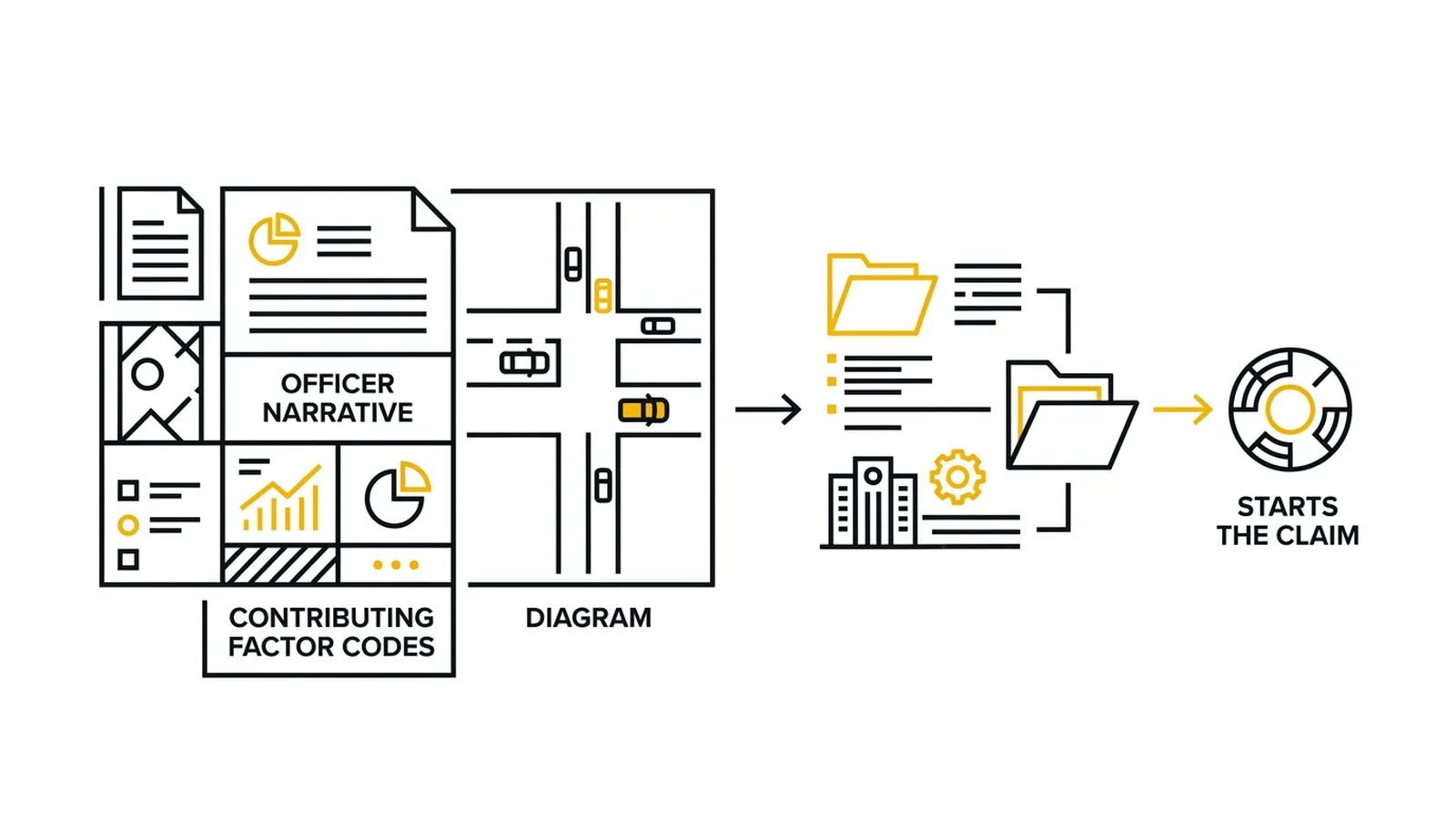
The report starts with the officer's narrative. After a brief investigation, the responding officer talks to the parties, looks at the evidence at the scene, and writes what happened from the officer's point of view.
You will also see contributing factor codes assigned to each driver. They may show that one driver failed to yield the right of way, drove carelessly, or followed too closely. In effect, the codes allocate fault the way the officer sees it. The report also carries a diagram of vehicle positions, direction of travel, and the approximate point of impact, along with driver statements, witness names and contact details, any citations, and the officer's notes on injuries and who went to the hospital.
How insurance companies use it
The insurance carriers will pull the report and gather any evidence they can from it. The adjuster reads it and decides, inside the office, what percentage of fault each party may carry. The report helps decide which claims get fast-tracked, which get investigated further, and which may be denied at the outset.
The report also gives our firm the insurance information for everyone involved, which lets us open the claims. That includes a claim with your own insurer for PIP, and a claim with your uninsured or underinsured motorist carrier if you have that coverage.
If the report does not make clear who the officer believes was at fault, more of the burden falls on us. We then have to find independent witnesses, get statements, and look for surveillance.
Why the report stays out of the courtroom
Here is the part most people get wrong. Florida keeps a crash report made by a person involved in the crash, and any statement that person gives an officer for the report, out of evidence at trial. It is commonly called the accident report privilege.
The reasoning is that drivers will give honest information to the investigating officer without fear that it will be used against them in court. Florida's crash report statute, section 316.066, creates it.
So the report is a starting point, not a trial exhibit. The information in it, such as witness statements, photographs, and scene measurements, may come in through the Florida Evidence Code and the rules of evidence. In pre-litigation, insurance carriers use the report during negotiations. At trial, we cannot rely on it. Cases get won through admissible evidence anchored to, but not derived from, the crash report.
What the officer can say
The contributing factor codes and the narrative drive the carrier's evaluation before a lawsuit is filed. A citation, if one was issued, may also be used in pre-suit negotiations.
At trial, an officer can be subpoenaed to testify about facts observed at the scene. That includes where the vehicles were when the officer arrived and the physical evidence. What the drivers told the officer for the crash report generally stays out under the accident report privilege. Generally, an officer cannot offer an opinion on who was at fault. Body camera footage can come in too, if it is authenticated properly.
If the officer did not come, or got it wrong
If no officer comes to the scene, you still have reporting duties. A driver in a crash with an injury, a death, or apparent property damage of at least $2,000 must immediately notify the local police, the sheriff, or the Highway Patrol. A driver in a crash that does not require a law enforcement report must submit a written report to the Florida Department of Highway Safety and Motor Vehicles within 10 days.
Florida's crash report portal is where reports are retrieved, with the diagrams and documentation that go with them.
If you notice an error, contact the investigating agency, whether that is the Florida Highway Patrol, the sheriff's office, or the city police department, and request a supplemental report. Send photographs, witness statements, or other documents that show the error. Contributing factor codes can be challenged through the agency's formal correction process. Keep every written request, with the date and the nature of what you asked, to show you tried.
The original report stays in the file even after a correction, so the full context still matters. If you are having trouble, work with your attorney so the correction can be escalated to the right people. The firm's frequently asked questions are a place to start.
Common Questions
- Can I use the police report in a Florida car accident lawsuit?
- Generally no. Florida's accident report privilege keeps a driver's crash report and statements to the officer for that report out of evidence, and we do not rely on the report itself at trial. The witness statements, photographs, and physical evidence behind it may come in through the rules of evidence. The report is where the investigation starts, not where the case is proven.
- What do the contributing factor codes mean?
- They are the officer's assignment of how each driver contributed to the crash, such as failing to yield the right of way, careless driving, or following too closely. Insurance adjusters use them to form an early view of fault, which is why an incorrect code is worth correcting.
- What if the crash report has a mistake?
- Contact the agency that wrote it and request a supplemental report. Include photographs, witness statements, and anything else that shows the error. You can also challenge a contributing factor code through the agency's correction process. Keep written requests, because the original report stays in the file.
- What if no officer came to the scene?
- You still have to report the crash. If anyone was hurt, or the apparent property damage is at least $2,000, notify the local police, the sheriff, or the Highway Patrol right away. Otherwise a written report goes to the state within 10 days. The report gives you documentation for the claim.
Chapter Reflection
A crash report feels official, so people treat it as the last word. It is the first word. It starts the claim, it shapes how an adjuster opens the file, and a driver's report and statements to the officer stay out of evidence. The cases that succeed are built on evidence that can survive without it.