
After a crash, the at-fault driver's insurance company will call you. The call can come fast, even while you are still at the scene. I want you to understand what that call is for before you answer it.
This chapter covers recorded statements, quick releases, social media, and the tools an insurance company uses to challenge an injury.
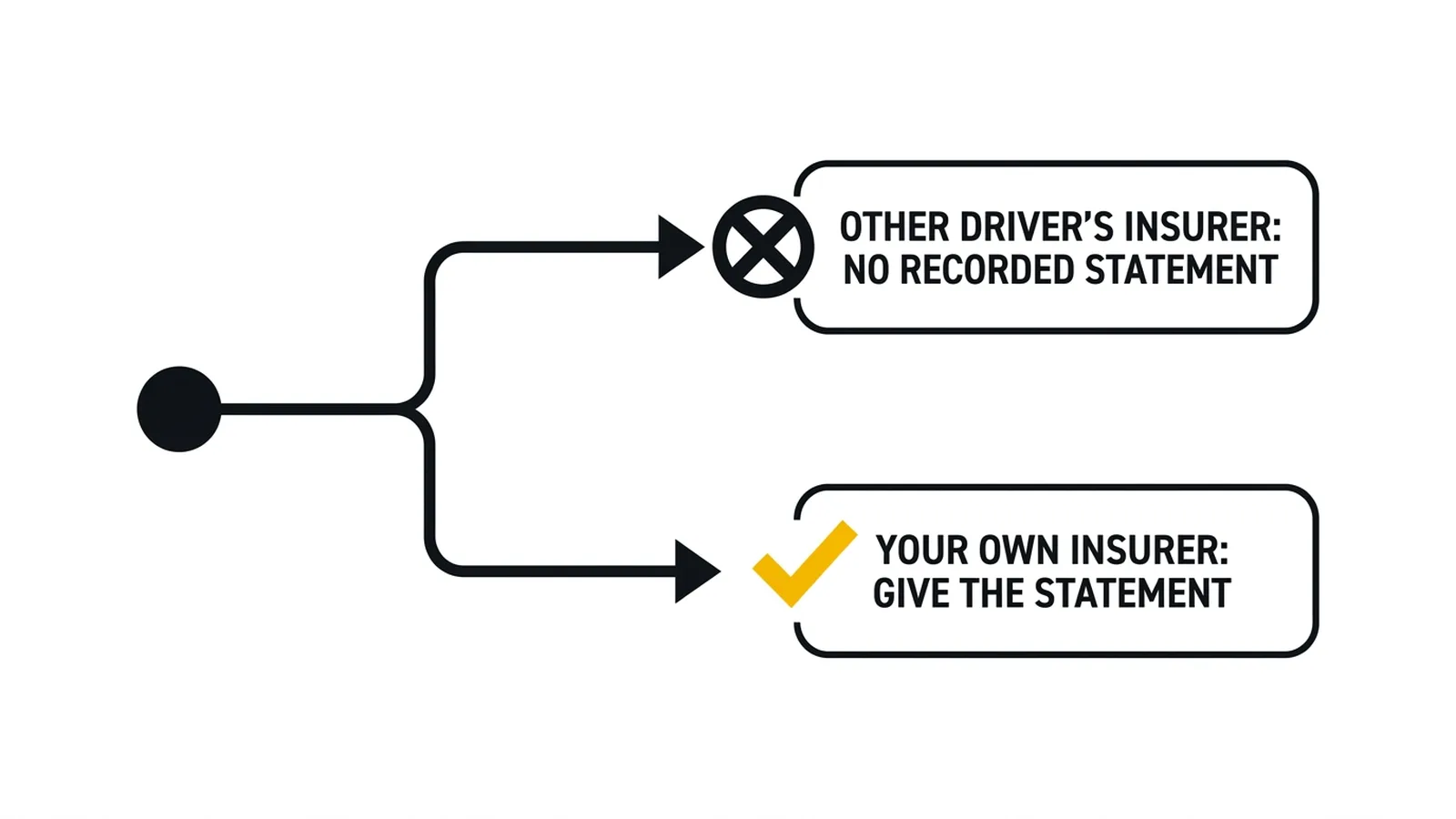
Again, you do not have to give one to them. We do not allow our clients to give third-party recorded statements. However, your own auto insurance may be entitled to take your recorded statement, and at that point it is important that you give them the recorded statement because otherwise they could deny coverage on your policy.
Two insurance companies, two different answers
A lot of times the at-fault party's insurance company will ask for a recorded statement. You do not have to give one to them. The firm's article on what not to say to an insurance company after an accident looks at the same subject.
Your own auto insurance is different. Your own company may be entitled to take your recorded statement. At that point it is important that you give it, because otherwise they could deny coverages on your policy.
The quick release
Here is a pattern I see often. The at-fault party's insurance company reaches out and offers $1,000. They send a DocuSign release and say the check will be direct-deposited into your account once it is signed.
People sign. They get $1,000. The next day they are in the hospital with pain that never went away, and the ER visit alone is $10,000. They call us, and by then they have already released the at-fault party. Unfortunately, if the case has been settled and the releases are signed, there is nothing we can do for them at that point.
We have had clients tell us that the other party's insurance company reached out while they were still on the accident scene. If the company can get a release signed for a couple of dollars, the person may have waived their claim for any other money they could have recovered.
Admissions and social media
The common mistakes I see are giving a recorded statement to the at-fault party's insurance company, giving information and admitting fault when the fault was not yours, and posting a lot on social media. Keep your car accident and your injuries to yourself. You should not be posting about them or telling everybody.
Social media gets watched. Insurance companies look at a claimant's accounts for activity that does not match the claimed injuries or the testimony. They may also hire a private investigator to capture video of a claimant doing something they say they cannot do.
The medical exam the defense orders
In a lawsuit, the defense can ask for a compulsory medical exam, which is also called an independent medical evaluation, and the court allows it when the defense shows good cause. It is an exam by a physician paid by and affiliated with the defense, and that physician may become their expert at trial. Their goal is to challenge the findings in the treatment you underwent.
The search for an old injury
The insurance carrier will usually obtain your full medical history. They want to argue that you have a preexisting condition and that the crash did not cause your injuries. Luckily, Florida has the eggshell plaintiff doctrine from Chapter 5, which says a plaintiff is taken as they are found on the day of the crash. The firm has also published an article on when insurance companies deny valid car accident claims.
Common Questions
- Do I have to give the other driver's insurance company a recorded statement?
- No. You do not have to give a recorded statement to the at-fault party's insurance company, and we do not allow our clients to give third-party recorded statements. Your own insurer is different, and refusing them could lead to denied coverage, so talk to an attorney before you answer either call.
- Should I sign a release or settlement check from the insurance company?
- Not before talking to an attorney. A release can waive your claim for any other money you might have recovered. I have seen people sign for $1,000, then end up in the hospital the next day with a bill that dwarfs the payment.
- Can insurance companies look at my social media?
- Yes. They look for activity that is inconsistent with your claimed injuries and your testimony, and they may hire private investigators to film you. Keep your crash and your injuries off social media while your claim is open.
- What is a compulsory medical exam?
- It is an exam of the claimant by a physician affiliated with the defense, requested in a lawsuit and allowed when the defense shows good cause. The physician may later become the defense's expert at trial. The goal is to challenge the findings of your own treating doctors.
Chapter Reflection
These tools work the same way. A recorded statement, a signed release, a social media post, and a defense exam each give the insurance company something it can use to shrink the claim. Knowing what the call is for is the first protection.