
From Claim to Settlement: The Steps of a Florida Car Accident Case
A car accident claim has many moving parts, and most people have never seen one from the inside.
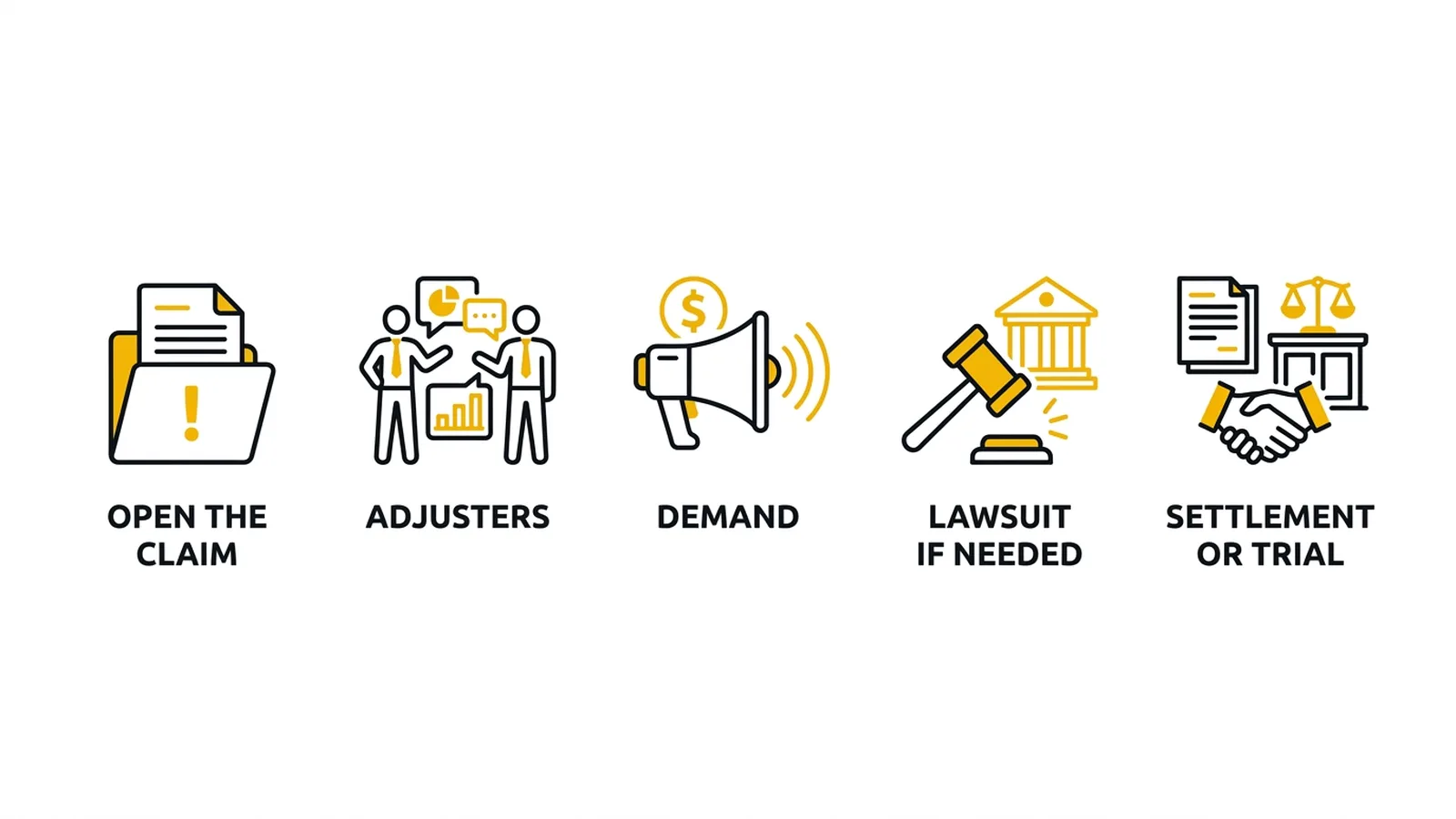
This chapter walks through the steps: opening the claim, the adjusters, the demand, a lawsuit if one is needed, and how most cases end.
Often you'll find that the insurance company's initial offer is very, very much a lowball offer. If they can get you to settle your claim for pennies on the dollar, then they will, because it's less money that they have to pay out of their pocket.
Step one: find the insurance company and open the claim
The first step is to learn the other party's insurance company, so that you can see where and with whom to file a claim. That is usually found on the crash report. Sometimes the responding officer gives you a short form at the scene with everybody's insurance information. Other times you have to wait for the long form, the fully filled-out crash report.
From there, you call the insurance company and set up the claim.
Step two: the adjusters
The company assigns adjusters. If you claim bodily injuries, they will generally assign a bodily injury adjuster, and a property damage adjuster as well. The adjusters work through the file and try to settle the case with you.
That is why I say to contact us right away. Often the first offer is a lowball offer. The firm has also published a list of common mistakes to avoid when filing a car accident lawsuit.
Step three: the demand
In the pre-litigation stage, we commonly send a demand letter once a client has reached maximum medical improvement, which is commonly called MMI. If the insurance carrier has already accepted liability, the demand often helps fast-track the claim.
Insurance adjusters often have only limited settlement authority, so we push them to get more authority if the case demands it.
Step four: a lawsuit, when it is needed
If the insurance company is not treating the client fairly, we prepare to file a lawsuit. Florida's proposal for settlement statute, section 768.79, lets a party make a formal offer to settle for certain terms and an amount. If it is not accepted, it can trigger fee shifting when the judgment comes in at least 25 percent above a plaintiff's offer or at least 25 percent below a defendant's offer.
Once a case is in litigation, discovery includes interrogatories, requests for production, requests for admission, and depositions. Depositions of the at-fault driver, witnesses, treating physicians, and defense medical examiners lock in testimony. We organize the evidence into a matrix that ties it to the elements of negligence and to damages. Expert disclosures are required, with supporting reports.
Insurance companies are also subject to bad faith exposure when a carrier fails to settle a claim within the policy limits when it could have and should have. Since 2023, negligence alone is not bad faith, and an insurer that tenders the lesser of its policy limits or the amount demanded within 90 days of notice of a claim with sufficient supporting evidence is protected from a bad faith action. Claimants and their attorneys also owe a duty of good faith in making demands and setting deadlines.
How most cases end
Currently, approximately 78 percent of our cases settle without the need to file a lawsuit. Florida's time standard for most jury cases is 18 months from service of the lawsuit to final disposition. Mediation is typically ordered by the court before trial. I would say probably 70 percent of cases that get that far settle at mediation, where a neutral third party, usually a retired attorney or retired judge, helps both sides negotiate. Since COVID, we mostly do it over Zoom.
If a case does not resolve, it goes to trial. The insurance company runs a cost-benefit analysis, and when the evidence is strong, its defense costs make settlement more attractive than litigation. That is especially true when the carrier knows we have a dedicated trial team that will try the case.
Common Questions
- What are the steps of a Florida car accident claim?
- You identify the other driver's insurer, usually from the crash report, and open a claim. Adjusters are assigned, and we send a demand once treatment has reached maximum medical improvement. If the insurer will not treat the client fairly, we file a lawsuit, take discovery, mediate, and try the case if it does not resolve.
- How long does a car accident lawsuit take in Florida?
- Florida's time standard for most jury cases is 18 months from service of the lawsuit to final disposition. During those months depositions are taken and discovery is exchanged, and the court typically orders the case to mediation before trial.
- What percentage of car accident cases settle?
- Currently, approximately 78 percent of our cases settle without a lawsuit. Of cases that go into litigation, I would say probably 70 percent settle at mediation. The rest move forward to trial, which is why we prepare every case as if it is going to trial.
- What is a proposal for settlement?
- It is a formal written offer to settle a lawsuit for a specific amount, served on the other side under Florida's offer of judgment statute. The other side has 30 days to accept. If it doesn't, the side that rejects it risks paying the other side's attorney's fees and costs. A defendant who makes an offer can recover them if the judgment is one of no liability or the final judgment comes in at least 25 percent below the offer. A plaintiff who makes a demand can recover them if the final judgment comes in at least 25 percent above it. It is a common tool once a case is in litigation, because it gives the other side a reason to settle.
Chapter Reflection
From the outside, a claim looks like a long wait. From the inside, it is a sequence of steps that starts with the first call to an insurance company and, for most cases, ends before a trial. Knowing the order lets you see where you are.