
Insurance Coverage in Florida: Bodily Injury, Uninsured Drivers, and Gaps
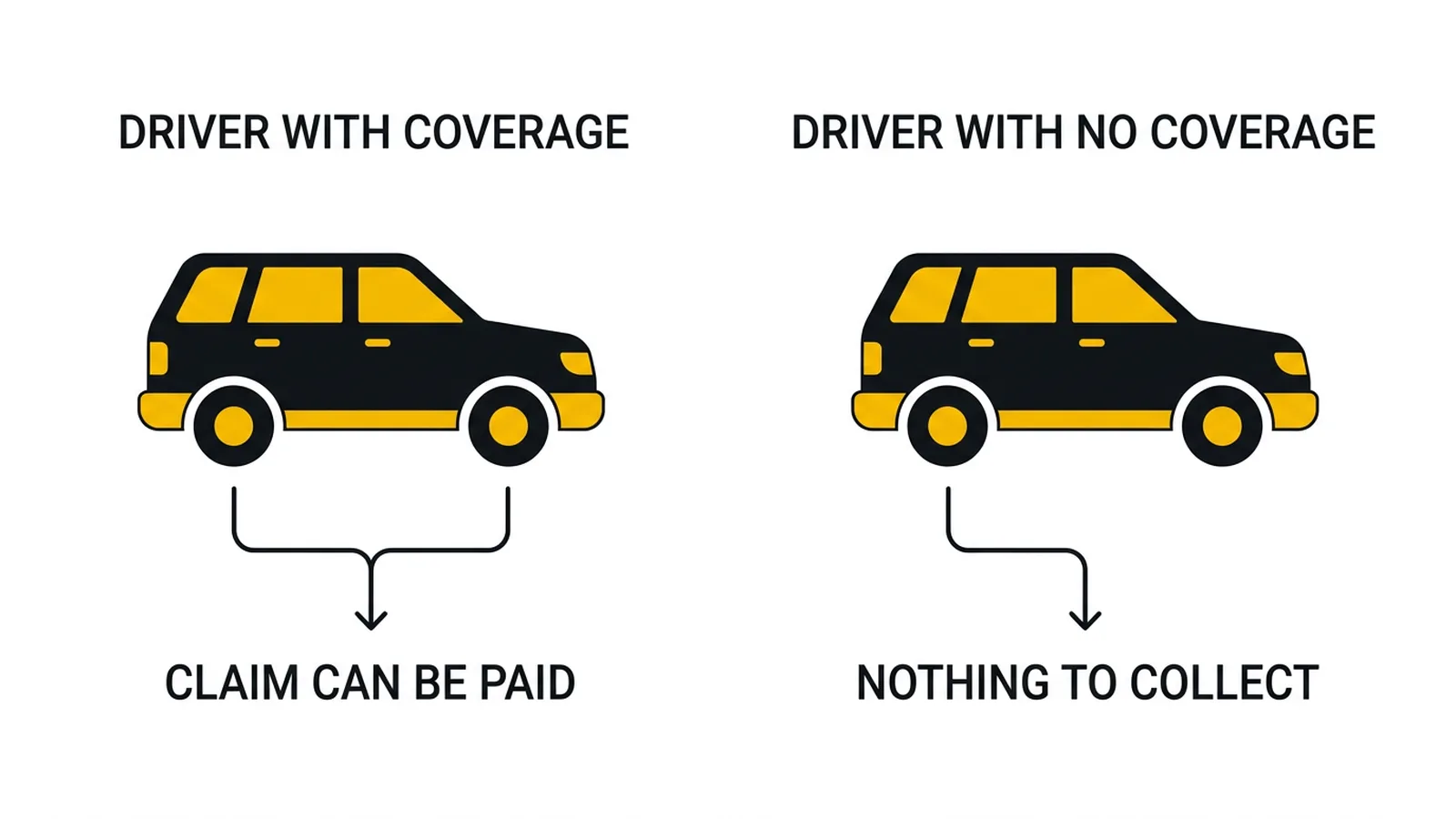
Two drivers can cause the same crash and leave two completely different outcomes behind. The difference is often insurance. One at-fault driver carries coverage that can pay for an injury. The other carries nothing.
Florida makes this problem worse than most states do, and I would rather you hear it from me before a crash than after one.
You know, the old statement, you can't get blood from a stone. These people drive around with no insurance and they have nothing. So they cause these huge injuries, life-altering injuries.
Bodily injury coverage is optional here
Bodily injury coverage is the part of a policy that pays another person when you injure them. Florida does not require it. In Florida it is an elective coverage, which means a driver can legally be on the road without it.
If you carry bodily injury coverage, your insurance company pays for the injuries of another person you hurt. If you do not, a person you hurt may have nothing to collect from but you.
What limits people buy
Commonly, people carry $10,000 of bodily injury coverage. From there you see limits of $25,000, $50,000, $100,000, $250,000, and $500,000. People with higher limits often add an umbrella policy.
Higher limits matter to you in both directions. They protect you if you cause a crash and injure somebody, because the coverage can protect you from being sued personally.
When the other driver has nothing
This is the part I find hardest. Florida has no bodily injury requirement, and so many times we see horrible collisions where the person who caused the crash has no coverage. The injuries can be as serious as paralysis, missing limbs, or death.
I would say probably 35 to 40 percent of the time, there is nothing we can recover for our clients. That is a hard number to say out loud, and it is why I will not oversell a claim to anybody.
Uninsured and underinsured motorist coverage
The coverage that helps when the other driver has nothing is one you buy yourself. It is called uninsured and underinsured motorist coverage, commonly abbreviated UM or UIM, and it sits on your own vehicle's policy. Florida's uninsured motorist statute, section 627.727, governs it.
Uninsured motorist coverage is subject to the same permanence threshold for pain and suffering damages that Chapter 5 describes. If you do not have it, a lot of times we may not be able to make a recovery for you at all.
Commercial vehicles and layers of coverage
When a commercial vehicle is involved, there are federal guidelines the company has to follow, and there may be different layers of coverage. The tractor of a tractor-trailer may have coverage. The trailer may have its own. The agency that booked the route for the driver may add another layer. The firm's article on handling Florida insurance after a multi-vehicle accident looks at a related situation.
Local commercial vehicles are different. Florida sets minimum combined bodily injury and property damage liability coverage for commercial vehicles by weight: $50,000 for 26,000 pounds or more but under 35,000, $100,000 for 35,000 pounds or more but under 44,000, and $300,000 for 44,000 pounds or more. A commercial vehicle under 26,000 pounds may carry less. A local truck can cause severe and permanent injuries, and even the minimums may not come close.
How much insurance you should buy
Everyone is in a different situation. Buy enough to protect your assets. If you have a high net worth, you do not want to carry only $10,000 of insurance. In my opinion, you want enough coverage to protect everything you have accumulated over your lifetime.
Common Questions
- Does Florida require bodily injury insurance?
- No. Florida does not require it. Bodily injury coverage is elective here, which means a driver who hurts you may have none. That is why your own uninsured motorist coverage matters, because it is the protection you buy for exactly that situation.
- What is UM/UIM coverage?
- UM and UIM stand for uninsured and underinsured motorist coverage. It is coverage you purchase yourself, on your own vehicle, and it can respond when the driver who caused your crash has no insurance or too little. Without it, a recovery may not be possible.
- What if the at-fault driver has no insurance?
- You may have very little to collect from. I would say probably 35 to 40 percent of the time we cannot recover anything for our clients. Your own uninsured motorist coverage is the main protection, and PIP still covers part of your medical bills.
- How much auto insurance should I carry in Florida?
- Enough to protect your assets. If you have a high net worth, do not carry only $10,000 of coverage. Bodily injury coverage protects you from being sued personally if you injure someone, so match your limits to what you have to lose.
Chapter Reflection
Nobody buys insurance to win a claim. You buy it for the day somebody else's mistake lands on you. Florida asks drivers to decide that without requiring bodily injury coverage, and the gap shows up in the claims that cannot be paid.